

Categories
Archives
- October 2012
- September 2012
- May 2012
- April 2012
- March 2012
- November 2011
- October 2011
- September 2011
- July 2011
- May 2011
- April 2011
- March 2011
- February 2011
- October 2010
- August 2010
- May 2010
- March 2010
- February 2010
- November 2009
- September 2009
- July 2009
- June 2009
- May 2009
- April 2009
- March 2009
- February 2009
- December 2008
- October 2008
- September 2008
- July 2008
- June 2008
Purchase page
Purchase page has been changed. Before, it had a lot of text and links. But today I decided to simplify it and make it as easy as possible.
As a result, we can now see the link on the page for each product - NetStat Agent and Real NetStat. In addition, volume discounts are moved to a separate page.
Hopefully this will give me new customers! 
- March 9th, 2012
- 0 Comments
What will be new in NetStat Agent 3.2?
At the middle of February will be released a new version of NetStat Agent.
In this version will be improved only netstat tool. We plan to add a filter for a quick search as we already have in Handy Uninstaller software.
Also we plan to increase the price per NetStat Agent unit with new version release. So you have a good chance to by per life license for only 29.95 USD!
- February 1st, 2011
- 0 Comments
Run batch scripts with NetStat Agent
In NetStat Agent 3.1 we added an ability to run batch scripts (in previous versions only executable files could be run). And because a launched third party program can show a window, we added new properties to user interface: program parameters (such as process name, remote ip, etc.) and an option to show\hide a program window.
On current moment the program supports the following parameters:
Continue reading Run batch scripts with NetStat Agent
- October 9th, 2010
- 0 Comments
What is my IP address?
Sometimes it is useful to know your external IP address. For example, when you share HTTP/FTP server and you do not know or forgot your IP address. In this case, if you use NetStat Agent 3.0 every time, it will be very easy for you! Because you do not need to open the Internet browser and search for a special service.
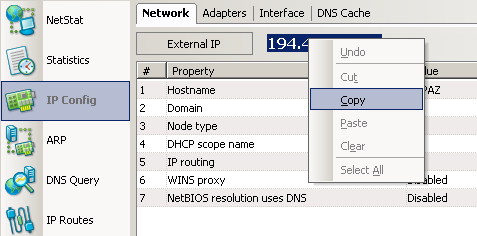
To find your IP address you must open IPConfig tool and press External IP button. After a few seconds you will see your external IP address. You may copy it to a clipboard (the right mouse click).
- March 26th, 2010
- 0 Comments
What does event column mean?
Question
“I have logged NetStat acitivity for a couple of days. I am analyzing the log now. I cannot find a definition of what can be recorded in the Event Column. What exactly does changed mean? What exactly does new mean? What exactly does removed mean?”
Answer
Event Columns means a log record status, for example:
1) You click on file in your browser and the browser opens a TCP connection to download file.
2) At this moment NetStat Agent (NA) found that your browser opened a new connection, so because it is a new connection, NA sets a record status as “New”.
3) But when your browser downloaded a file, it closes the opened connection and at this moment NA writes to log file that connection is closed and sets a record status as “Removed”.
A record status “Changed” means that connection state (see column “Status” in NetStat window) is changed, for example:
1) Let assume you run Skype and connected to Skype server.
2) In this case NA will find a TCP connection with status - “ESTABLISHED”.
3) Then you decide to close Skype (disconnect).
4) It means that your PC (Skype application) will send a FIN packet (a TCP signal to close connection) to a remote host (Skype server).
5) For your PC it means a changing connection status from ESTABLISHED to FIN_WAIT1.
6) So when NetStat Agent detects connection status changes it writes to log file what connection is changed and sets a record status as “Changed” to event column.
- March 4th, 2010
- 0 Comments